


Key takeaways
- A discharged 12V battery may prevent smart entry and other electrical systems from operating normally.
- Most Toyota vehicles include a mechanical back-up key that can be used to unlock the vehicle.
- Vehicles equipped with electronic door-release systems include manual override mechanisms that can be used if electrical power is unavailable.
- The location and operation of manual door releases varies by model. Click this link to see an online version of the owners’ manual for your vehicle.
- If you’re concerned about the condition of your vehicle’s 12V battery, your Toyota retailer can carry out a free battery inspection.
- The information in this article is relevant to Toyota models sold in the UK.
Introduction
While Toyota vehicles are engineered for reliability, like any modern vehicle they depend on a 12V battery to power many electrical systems. If that battery becomes fully discharged, functions such as keyless entry and certain electronic door systems may not operate as normal. Fortunately, most Toyota vehicles include alternative methods for entering and exiting the vehicle if your Toyota won’t unlock. In this guide, we explain what to do if you experience a completely discharged 12V battery and where to find further model-specific information.
Why won’t my Toyota unlock?
If you approach your vehicle and smart entry is not working, in many cases, the cause may be something simple such as a depleted key battery.
However, if the vehicle’s 12V battery is fully discharged, smart entry and other electrical functions may not operate as expected.
The good news is that Toyota vehicles are designed with alternative methods of entering and exiting the vehicle should electrical power become unavailable.
Lost car keys? Click here to read our advice.
What is smart entry on my Toyota?
Smart entry allows you to lock and unlock compatible Toyota vehicles without removing the key from your pocket or bag. It is advisable for the vehicle’s driver to always carry the electronic key.
When operating normally, the vehicle recognises the presence of the smart key via weak radio waves and enables convenient access to the vehicle. If either the key battery or the vehicle’s 12V battery becomes depleted, smart entry may not function as expected.
Before assuming the vehicle’s battery is flat, it may be worth checking:
- Whether the key battery needs replacing. For vehicles with a smart entry and start system, the average life for a battery in a key is between one and two years, regardless of whether the key is regularly used or not. If the smart key’s battery becomes low, an alert will sound in the cabin and a message will be shown on the vehicle’s multi-information display.
- Whether the key is within operating range. In most Toyota vehicles, the system can be operated when the electronic key is within about 0.7 metres (2.3 feet) of an outside door handle. Only the doors detecting the key can be operated.
- Whether there is any potential signal interference nearby from any facility that could be generating strong radio waves or electrical noise. Examples include: TV towers, electric power plants, radio stations, large displays or airports.
- Whether the vehicle has been left unused for an extended period. In some vehicles, if the smart entry has not been used for 14 days or longer, the vehicle might not unlock from any door except the driver’s door. In this case, press the button on the driver’s door handle, or use the wireless remote control or mechanical key (read below for more information) to unlock the doors.
How to enter your Toyota if the 12V battery is flat
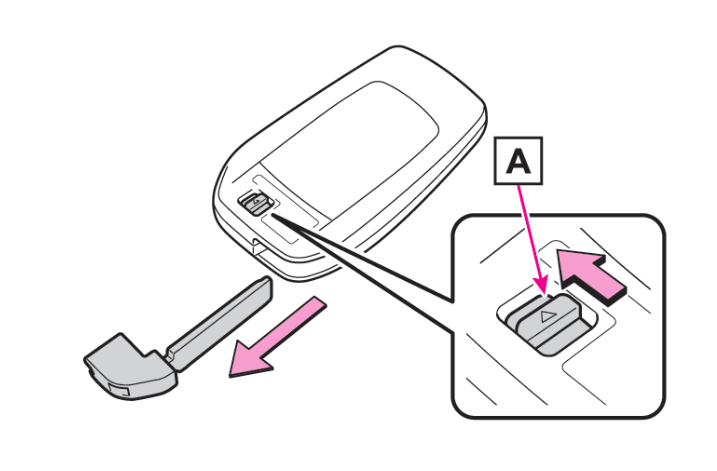
Most Toyota smart keys incorporate a mechanical emergency key that can be used when electrical systems are unavailable.
Although the exact procedure varies between models, the process typically involves:
- Removing the mechanical key from the smart key.
- Locating the concealed key lock cylinder on the driver’s door (usually accessible behind a small panel on the door handle).
- Unlocking the vehicle manually. The mechanical key can only be inserted in one direction, as the key only has grooves on one side. If the key cannot be inserted in a lock cylinder, turn it over and re-attempt to insert it.
Once inside the vehicle, you may need roadside assistance, a battery recharge or a jump-start procedure depending on the cause of the issue.
Always refer to your owner’s manual for instructions specific to your model of Toyota.
How to exit your Toyota if electrical power is unavailable
Many Toyota vehicles use conventional mechanical interior door handles, which can still be operated even if the 12V battery is discharged.

Some newer vehicles may be equipped with electronic door-release systems. Vehicles equipped with these systems also incorporate manual override mechanisms that allow occupants to open the doors if electrical power is unavailable and your Toyota won’t unlock.
The location and operation of these manual releases can vary by model, so owners should familiarise themselves with the relevant instructions in their handbook.
Smart entry and emergency door access by model
| Model | Smart entry available?* | Electronic door-release system fitted?* | Manual entry method if needed | Manual exit method if needed |
| Aygo X Hybrid | Excel, GR Sport grades (optional on Design grade when Parking Pack specified) | No | Mechanical key (Icon); Mechanical key in fob (Design when Parking Pack specified, GR Sport, Excel) | Standard manual door release |
| Yaris | Design, GR Sport, Excel grades | No | Mechanical key (Icon); Mechanical key in fob (Design, GR Sport, Excel) | Standard manual door release |
| Yaris Cross | Icon, Design, GR Sport and Excel grades | No | Mechanical key in fob | Standard manual door release |
| Urban Cruiser | Icon, Design, Excel grades | No | Mechanical key in fob | Standard manual door release |
| Corolla Hatchback and Touring Sports | Icon, Design, GR Sport and Excel grades | No | Mechanical key in fob | Standard manual door release |
| Toyota C-HR | Icon, Design, GR Sport and Excel grades | No | Mechanical key in fob | Standard manual door release |
| Toyota C-HR+ | Icon, Design, Excel grades | No | Mechanical key in fob | Standard manual door release |
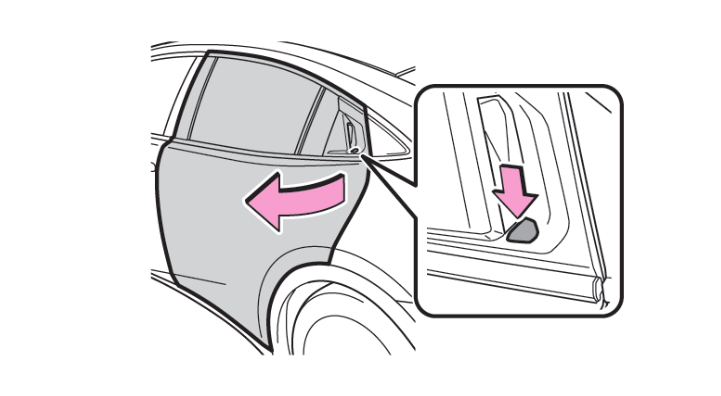
| Prius Plug-in Hybrid | Design and Excel grades | On exterior of rear side doors only | Front – mechanical key in fob; rear – firmly press manual release button at bottom of door switch | Standard manual door release |
| bZ4X | Icon, Design, Excel grades | No | Mechanical key in fob | Standard manual door release |
| bZ4X Touring | Design and Excel grades | No | Mechanical key in fob | Standard manual door release |
| All-new RAV4 | Icon, Design, GR Sport and Excel grades | No | Mechanical key in fob | Standard manual door release |
| Land Cruiser | Invincible grade | No | Mechanical key in fob | Standard manual door release |
| Proace City Verso | Design grade | No | Mechanical key in fob | Standard manual door release |
* Availability correct at the time and date of article publication, but may vary according to model grade, specification and model year.
What causes a 12V battery to discharge?
Like all vehicles, Toyota models rely on a 12V battery to support a range of electrical functions. Battery condition can be influenced by several factors, including vehicle usage patterns, journey type, environmental conditions, electrical demand and battery age.
If you regularly make short journeys, leave the vehicle unused for extended periods or have concerns about battery performance, it may be worth consulting your local Toyota retailer. Read more about caring for your vehicle’s 12V battery – How to care for your car’s 12V battery | Toyota UK
Can Toyota check my battery’s condition?
Yes. Customers who have concerns about the performance or condition of their vehicle’s 12V battery are encouraged to contact their local Toyota centre. Toyota retailers can carry out 12V battery quality inspections and, where appropriate, recommend further action.
Where can I find more information?
Owners’ manuals and user guides for Toyota’s current model range feature can be found at this link.
Frequently asked questions
Can I unlock my Toyota if the battery is completely flat?
In many cases, yes. Most Toyota smart keys include a mechanical key that can be used if keyless entry is unavailable.
Does a flat 12V battery stop smart entry from working?
A fully discharged 12V battery may prevent smart entry and other electrically operated features working normally.
Can I get trapped inside the vehicle if electrical power is lost?
Vehicles equipped with electronic door-release systems include manual override mechanisms that allow doors to be opened when electrical power is unavailable, such as the manual key.
Where is the interior door release located?
The location varies by model. Refer to your owner’s manual for specific instructions relating to your vehicle.
Does a flat 12V battery mean there is a problem with the hybrid battery?
Not necessarily. The 12V battery and hybrid battery perform different functions within the vehicle.
Who should I contact if I need assistance?
If you’re unable to access or start your vehicle, contact Toyota Roadside Assistance, your retailer or Toyota Customer Relations for support. Use our dealer locator to find your nearest centre.



I do about 9k km pa. My Yaris has twice in 5 years been immobilised by the 12v battery dying. Both times during cold weather and after a few days of non or low usage. The manual says after locking it I should press the keys “open” button quickly twice then hit the unlock button. This disconnects the key fob from the car’s system which uses up a lot of energy. Just got to remember to do it.
Had a flat 12v battery on my new CH-R hybrid after 2 weeks on a cruise. Toyota eventually conceded there was a problem and replaced the battery after which it was fine. With regard to the key battery warning, I had none on my 1 year old RAV4 PHEV when it suddenly wouldn’t start and assumed it was the 13v battery again. Apparently the RAV4 has no key low battery warning?
Sorry Philip, please may you clarify your question?
I have a 2019 Toyota Yaris, is this car likely to suffer from the same battery issues?
Morning Amanda,
All modern cars drain the 12v battery when they are switched off. This is due to the onboard electrical systems. If the 12v battery is not given a chance to recharge often enough, it can go flat. Read more here and pick up some tips that, if followed, can help ensure your Toyota remains in tip-top condition: https://mag.toyota.co.uk/12v-battery-care/
If you experience any problems and would like your car to be inspected, please get in touch with your local Toyota Centre.
Thank you.
I have a 2025 RAV4 GR Sport PHEV and drive around 6000miles pa. I have experienced a flat 12v battery twice after a 2 week holiday. Toyota have fitted a higher capacity battery and sold me a solar panel for £90 but after 2 weeks of continuous sunshine with the car on the drive I have a low 12V battery warning on my Toyota App. I have now had to purchased a power pack for £125 to avoid being stranded…this is unacceptable in a car costing £50k.
Two friends have a Kia and Hyundai both of which have a button to enable them to start the car if the 12V battery is flat…it works, I am told, by using power from the drive battery.
As a world leading car manufacturer I find it unbelievable that Toyota have not engineered a solution to a problem that appears to affect all their hybrid vehicles.
Morning John,
We’re sorry to hear you’re experiencing some problems in your Toyota RAV4.
We continuously monitor vehicle performance and customer feedback and, where appropriate, introduce product and service enhancement as part of our commitment to continuous improvement. As part of our continuous product development activities, higher-capacity and charge acceptance batteries have been introduced on a number of models over time. These actions reflect our ongoing commitment to monitoring vehicle performance and implementing improvements where appropriate.
If you continue to experience issues, please don’t hesitate to get back in touch with your local Toyota Centre.
Thank you.
I have a Yaris Cross GR Sport on a 74 plate. The fact that you have highlighted a weak battery problem on these models and have subsequently upgraded the batteries on newer models means that the older batteries are not fit for purpose. Therefore I should be entitled to an upgraded 12v battery. I await your response.
Morning Leonard,
If you’re experiencing any problems with your Yaris Cross Hybrid, we’d recommend getting in touch with your local Toyota Centre to arrange an inspection.
Thank you.
Why was this information not brought to our attention when purchasing vehicle and there is no comprehensive hard copy of owners manual supplied with vehicle. Always having to look up something.
Morning Cole,
With the wide choice of powertrains available today, our Centres understand the importance of discussing a customer’s driving patterns and expected vehicle usage before recommending a particular vehicle. Toyota and Lexus have sold hybrid vehicles in the UK for more than 25 years, with over one million hybrid vehicles sold. We do not specify a minimum annual mileage requirement for our hybrid vehicles. As with any vehicle, 12V battery condition and lifespan are influenced by a variety of factors including driving patterns, journey types, vehicle usage, environmental conditions and battery age.
Battery performance considerations and customer guidance on maintaining battery health are common across the automotive industry and are not unique to Toyota or Lexus. Guidance can be found on both the Toyota & Lexus websites and customer magazines: https://mag.toyota.co.uk/12v-battery-care/
We remain committed to ensuring the information and advice provided to customers is accurate, up to date and supports informed purchasing decisions.
To access your owners’ manual online, please click here: https://www.toyota.co.uk/customer/manuals
Thank you.
I have been reading about locking/unlocking problems that people have had with Toyota cars because of issues with the 12-volt battery. I have a Corolla GR Sport (2L version) which I bought in September 2022 when it was 1 year old – it is now 5 years old.
I have to say that I have never had any problem locking/unlocking the car – my problem has been starting the car – that is getting to the READY mode. The dash panel lights up with warning comments but there is no READY signal. Fortunately I have a standby Jump Starter Powerbank that I bought some years ago (before the Corolla) when my neighbour showed me the one he bought after having starting problems with his C-HR during the Covid lockdowns.
The first occurrence was about a year ago (September/October 2025) when the car was 4 years old. (Note the 4 years.) It happened 2 or 3 times so I contacted the local Toyota dealer who tested the 12-volt battery sometime between Christmas 2025 and New Year. It tested ok and they said that I didn’t use the car enough. I asked about a new battery but was told that an overnight charge at the dealership would be the same as a new battery. I declined the offer as I could cope with the occasional failure with my Powerbank. My sister and a friend-of-a-friend have both had the same problem with their Yaris – they had been using a tyre inflator and “not doing enough mileage” respectively.
It has failed to start on 4 occasions during 2026. I spoke to the dealer again around June/July 2026 and got the same story about not using the car enough and suggested a Solar Trickle Charger after I asked how people went on who left their car at an airport for a fortnight. It was also suggested I left the car on the drive in READY mode while I was (say) in the garden.
I do about 5000 miles per year. Being retired the car does many irregular short journeys and can be stood for a few days but a day out can put up to 300 miles on the clock.
So when the car went for its annual service/MOT in August 2026 I asked to look at a Solar Charger and I bought a (recommended) 5-watt version to plug into the OBD port. So I connected this panel and left it on the dash board. After checking with an ammeter it was charging at 100 milliamps – not very much I thought – but I don’t know what the standing drain is.
This was 10am on Friday morning : car was not used on Saturday and Sunday : at 10am on Monday morning (just 3 days later) the car wouldn’t start.
Apparently Argos sell the same OSRAM chargers as my Toyota dealers. On their website it says the 5-watt version is suitable for batteries with a capacity of up to 30 ampere-hours (AHs) – but my battery is 45AHs. After calling in the Toyota dealer and discussing this they agreed to exchange the 5-watt unit for a 10-watt version. I haven’t had chance to use it yet but I’m not holding any breath.
By coincidence – I was telling a friend about all this. He has an electric car (not a Toyota) that has a 12-volt battery as well as the Traction battery. He said that the Maintenance Schedule for his car recommends that the 12-volt battery be changed every 4 years. (Note the 4 years.)
So do Toyota know something we don’t and aren’t telling us. I bought a Toyota because out of all the version of Hybrid cars around these days I thought Toyota have been doing it longer than all the others so whatever system they use they have had time to get it right.
Might go back to Honda next time.
Want to have an mpg calculator after each trip. All I have at the moment is is a cumulative mpg figure
Answer please
Good morning,
You could download the MyToyota App to help with monitoring your journeys: https://www.toyota.co.uk/owners/connectivity/my-toyota-app
Thank you.
What a poor design of the 12v system. Surely Toyota should have worked this out if you do not do high miles in a day. Had to call AA out on my second hand 22 plate Yaris. The engineer said not another one and suggested I get a bigger battery fitted (£166) and buy battery Jump start booster. He showed me how to connect this to the 12v battery connection under the bonnet . Third Yaris I have had not good!!!
We have no faith in our new Yaris X, 4 call outs to th AA in the first month. I now carry a booster under my seat, in the boot is no good. Would not be able to access it.
I now use a battery charger once a fortnight to charge the battery from home.
Every time we go out my wife wonders if it will start
I have had Toyotas for 40 years and never had problems previously so these generations of hybrids leave me with little faith in Toyota.
Suffice to say that this will be my last purchase of a Toyota.
You canstill access the boot….pull the back seat down
I was contemplating getting a new Toyota, but certainly not now !
Morning Bhupinder,
As part of our continuous product development activities, higher-capacity and charge acceptance batteries have been introduced on a number of models over time, including the Yaris Cross Hybrid from October 2025. These actions reflect our ongoing commitment to monitoring vehicle performance and implementing improvements where appropriate.
Your local Toyota Centre will be happy to discuss any concerns you have or if you wish to arrange any test drives.
Thank you.