


Key takeaways
- A discharged 12V battery may prevent smart entry and other electrical systems from operating normally.
- Most Toyota vehicles include a mechanical back-up key that can be used to unlock the vehicle.
- Vehicles equipped with electronic door-release systems include manual override mechanisms that can be used if electrical power is unavailable.
- The location and operation of manual door releases varies by model. Click this link to see an online version of the owners’ manual for your vehicle.
- If you’re concerned about the condition of your vehicle’s 12V battery, your Toyota retailer can carry out a free battery inspection.
- The information in this article is relevant to Toyota models sold in the UK.
Introduction
While Toyota vehicles are engineered for reliability, like any modern vehicle they depend on a 12V battery to power many electrical systems. If that battery becomes fully discharged, functions such as keyless entry and certain electronic door systems may not operate as normal. Fortunately, most Toyota vehicles include alternative methods for entering and exiting the vehicle if your Toyota won’t unlock. In this guide, we explain what to do if you experience a completely discharged 12V battery and where to find further model-specific information.
Why won’t my Toyota unlock?
If you approach your vehicle and smart entry is not working, in many cases, the cause may be something simple such as a depleted key battery.
However, if the vehicle’s 12V battery is fully discharged, smart entry and other electrical functions may not operate as expected.
The good news is that Toyota vehicles are designed with alternative methods of entering and exiting the vehicle should electrical power become unavailable.
Lost car keys? Click here to read our advice.
What is smart entry on my Toyota?
Smart entry allows you to lock and unlock compatible Toyota vehicles without removing the key from your pocket or bag. It is advisable for the vehicle’s driver to always carry the electronic key.
When operating normally, the vehicle recognises the presence of the smart key via weak radio waves and enables convenient access to the vehicle. If either the key battery or the vehicle’s 12V battery becomes depleted, smart entry may not function as expected.
Before assuming the vehicle’s battery is flat, it may be worth checking:
- Whether the key battery needs replacing. For vehicles with a smart entry and start system, the average life for a battery in a key is between one and two years, regardless of whether the key is regularly used or not. If the smart key’s battery becomes low, an alert will sound in the cabin and a message will be shown on the vehicle’s multi-information display.
- Whether the key is within operating range. In most Toyota vehicles, the system can be operated when the electronic key is within about 0.7 metres (2.3 feet) of an outside door handle. Only the doors detecting the key can be operated.
- Whether there is any potential signal interference nearby from any facility that could be generating strong radio waves or electrical noise. Examples include: TV towers, electric power plants, radio stations, large displays or airports.
- Whether the vehicle has been left unused for an extended period. In some vehicles, if the smart entry has not been used for 14 days or longer, the vehicle might not unlock from any door except the driver’s door. In this case, press the button on the driver’s door handle, or use the wireless remote control or mechanical key (read below for more information) to unlock the doors.
How to enter your Toyota if the 12V battery is flat
Most Toyota smart keys incorporate a mechanical emergency key that can be used when electrical systems are unavailable.
Although the exact procedure varies between models, the process typically involves:
- Removing the mechanical key from the smart key.
- Locating the concealed key lock cylinder on the driver’s door (usually accessible behind a small panel on the door handle).
- Unlocking the vehicle manually. The mechanical key can only be inserted in one direction, as the key only has grooves on one side. If the key cannot be inserted in a lock cylinder, turn it over and re-attempt to insert it.
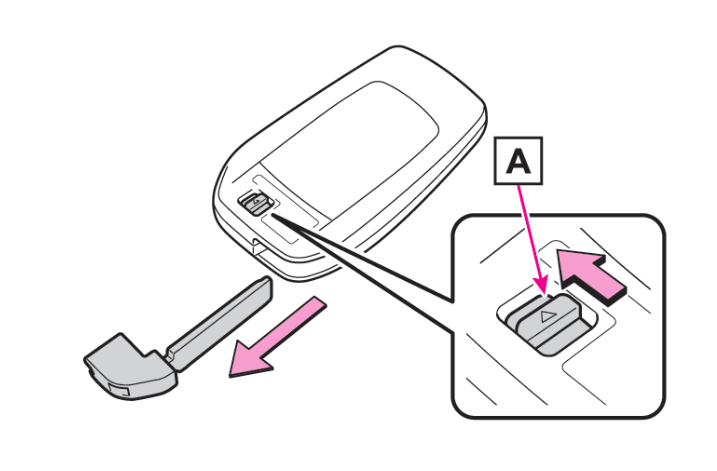
Once inside the vehicle, you may need roadside assistance, a battery recharge or a jump-start procedure depending on the cause of the issue.
Always refer to your owner’s manual for instructions specific to your model of Toyota.
How to exit your Toyota if electrical power is unavailable
Many Toyota vehicles use conventional mechanical interior door handles, which can still be operated even if the 12V battery is discharged.
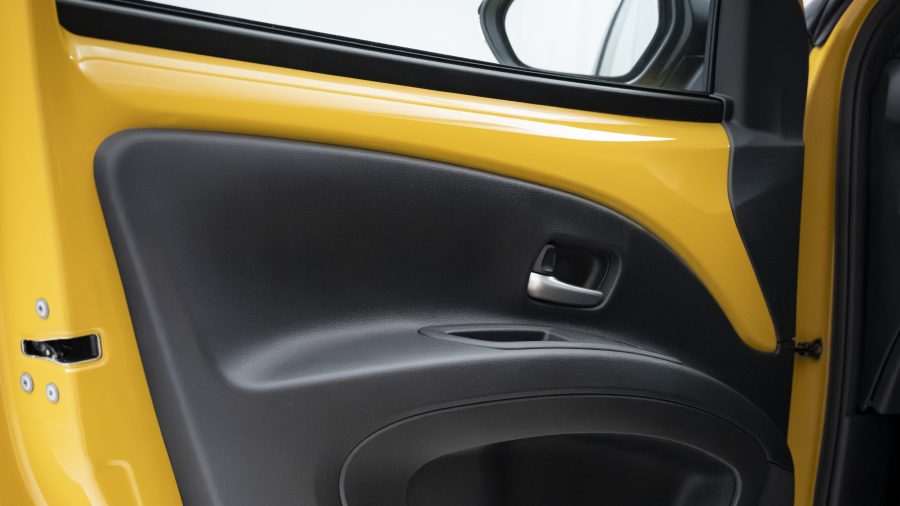
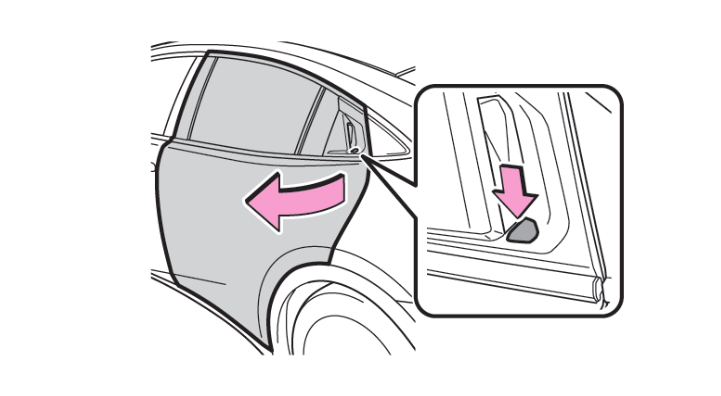
Some newer vehicles may be equipped with electronic door-release systems. Vehicles equipped with these systems also incorporate manual override mechanisms that allow occupants to open the doors if electrical power is unavailable and your Toyota won’t unlock.
The location and operation of these manual releases can vary by model, so owners should familiarise themselves with the relevant instructions in their handbook.
Smart entry and emergency door access by model
| Model | Smart entry available?* | Electronic door-release system fitted?* | Manual entry method if needed | Manual exit method if needed |
| Aygo X Hybrid | Excel, GR Sport grades (optional on Design grade when Parking Pack specified) | No | Mechanical key (Icon); Mechanical key in fob (Design when Parking Pack specified, GR Sport, Excel) | Standard manual door release |
| Yaris | Design, GR Sport, Excel grades | No | Mechanical key (Icon); Mechanical key in fob (Design, GR Sport, Excel) | Standard manual door release |
| Yaris Cross | Icon, Design, GR Sport and Excel grades | No | Mechanical key in fob | Standard manual door release |
| Urban Cruiser | Icon, Design, Excel grades | No | Mechanical key in fob | Standard manual door release |
| Corolla Hatchback and Touring Sports | Icon, Design, GR Sport and Excel grades | No | Mechanical key in fob | Standard manual door release |
| Toyota C-HR | Icon, Design, GR Sport and Excel grades | No | Mechanical key in fob | Standard manual door release |
| Toyota C-HR+ | Icon, Design, Excel grades | No | Mechanical key in fob | Standard manual door release |
| Prius Plug-in Hybrid | Design and Excel grades | On exterior of rear side doors only | Front – mechanical key in fob; rear – firmly press manual release button at bottom of door switch | Standard manual door release |
| bZ4X | Icon, Design, Excel grades | No | Mechanical key in fob | Standard manual door release |
| bZ4X Touring | Design and Excel grades | No | Mechanical key in fob | Standard manual door release |
| All-new RAV4 | Icon, Design, GR Sport and Excel grades | No | Mechanical key in fob | Standard manual door release |
| Land Cruiser | Invincible grade | No | Mechanical key in fob | Standard manual door release |
| Proace City Verso | Design grade | No | Mechanical key in fob | Standard manual door release |
* Availability correct at the time and date of article publication, but may vary according to model grade, specification and model year.
What causes a 12V battery to discharge?
Like all vehicles, Toyota models rely on a 12V battery to support a range of electrical functions. Battery condition can be influenced by several factors, including vehicle usage patterns, journey type, environmental conditions, electrical demand and battery age.
If you regularly make short journeys, leave the vehicle unused for extended periods or have concerns about battery performance, it may be worth consulting your local Toyota retailer. Read more about caring for your vehicle’s 12V battery – How to care for your car’s 12V battery | Toyota UK
Can Toyota check my battery’s condition?
Yes. Customers who have concerns about the performance or condition of their vehicle’s 12V battery are encouraged to contact their local Toyota centre. Toyota retailers can carry out 12V battery quality inspections and, where appropriate, recommend further action.
Where can I find more information?
Owners’ manuals and user guides for Toyota’s current model range feature can be found at this link.
Frequently asked questions
Can I unlock my Toyota if the battery is completely flat?
In many cases, yes. Most Toyota smart keys include a mechanical key that can be used if keyless entry is unavailable.
Does a flat 12V battery stop smart entry from working?
A fully discharged 12V battery may prevent smart entry and other electrically operated features working normally.
Can I get trapped inside the vehicle if electrical power is lost?
Vehicles equipped with electronic door-release systems include manual override mechanisms that allow doors to be opened when electrical power is unavailable, such as the manual key.
Where is the interior door release located?
The location varies by model. Refer to your owner’s manual for specific instructions relating to your vehicle.
Does a flat 12V battery mean there is a problem with the hybrid battery?
Not necessarily. The 12V battery and hybrid battery perform different functions within the vehicle.
Who should I contact if I need assistance?
If you’re unable to access or start your vehicle, contact Toyota Roadside Assistance, your retailer or Toyota Customer Relations for support. Use our dealer locator to find your nearest centre.


To a prospective buyer (me). This is just an awful response to what Which seem to say is a design problem with the affected cars. https://www.which.co.uk/news/article/toyota-lexus-12v-battery-failures-arkOC4N9honL
It has absolutely changed my buying decision about getting a car based on this platform – because I am a low mileage driver and I can’t afford for this sort of thing to happen.
Which are quoting Lexus LBX had a 29.2% battery problem rate and Toyota Yaris Cross was 19.1%
That is unacceptable.
Surely Toyota should be recalling the affected cars and changing the technology solution for new sales.
Morning Chris,
Thanks for getting in touch. We continuously monitor vehicle performance and customer feedback and, where appropriate, introduce product and service enhancement as part of our commitment to continuous improvement.
As part of our continuous product development activities, higher-capacity and charge acceptance batteries have been introduced on a number of models over time, including Toyota C-HR from January 2022, Toyota Corolla from January 2023, Toyota Yaris and Yaris Cross from October 2025 and Lexus LBX from April 2025.
These actions reflect our ongoing commitment to monitoring vehicle performance and implementing improvements where appropriate.
Thank you.
I went through this in first 6 months of purchasing my Yaris cross. Battery went flat 3 times had to call out AA 3 times. After the 3rd time I did masses of research and found that the vehicle only had a 32amp battery instead of a regular 45/48amp. Given that modern cars us A LOT of energy even when parked up, it became obvious to me that the battery was draining to flat within 7 days of being idle. To combat this problem I purchased a small solar panel that sits on the dash board and plugs into the OBD port, this feeds into the Battery management system and keeps the battery topped up when vehicle is not in use for a prolonged period of time. The advise to plug in a solar panel came from Toyota online spares help line. They are aware of the issue at head office but they don’t allow service and sales centers to offer advise on how to overcome the issue, the service centers are only allowed to offer you an over night bench charge. I also keep a kick start kit under my seat as a back up, I do not keep it in the boot as this is unopenable with the loss of power. During my research I used a battery tester which I plugged into the OBD port and discovered that the battery was using a half amp for every 24 hours the car was idle, that volume of loss can take you battery to critical non function within 5 to seven days depending on the batteries start point at time of car going idle.
Hi Barry, very interested in your answer to the battery problems. Where did you buy your Solar panel system from, I’m very interested in buying one myself.
Kind regards
Denis 077350*****
Barry
Could you provide me with details of where to buy the small solar panel and the cost please. I have had the same problem and on numerous occaions and had to call out the services of the AA. The advised getting a bigger battery.
Glynis
Can I ask Barry, which Solar Battery Maintainer have you purchased, I like yourself have done some research on them, Osram, formerly Ring do 5,10 and 20 watt panels, they advised me to get a 20 watt panel, but I noticed that they don’t have a light on the panel which when connected would show that power is going through the unit, the AA panel does, but the wattage is output is less.
Any advice would be much appreciated
Perhaps Toyota could offer suitable compensation / buy back vehicles that may have been miss-sold or fix the problem?
Morning Ian,
If you’re experiencing problems with the 12v battery in your Toyota, we’d recommend getting in touch with your local Toyota Centre to arrange a free battery quality inspection.
Thank you.
What is the point in responding to these comments. The toyota battery problems are known world wide. I have had serious 12v battery problems with my Bz. Thank goodness that I have the portable jump starter. I complained again about the battery problem during the cars last service. They kept it overnight and told me that there wasn’t a problem. 2 days later it was flat again. By this time I had had enough and purchased a better battery. I have had no problems since. Fogged off again by toyota GB.
I think Toyota need to advise their dealers that a battery check is free.
I purchased a used Yaris Cross in April and experienced issues with a flat 12v battery after a week where the car was parked up.
The AA mechanic who came out advised me to request a battery check.
I contacted the dealer I purchased the car from and was advised that the battery wasn’t covered on the extended warranty and they quoted me nearly £200 to carry out a battery check!
On querying this I was informed that they have a minimum charge for garage work. Ridiculous when I could get a battery for nearly half that price.
Toyota should also review their warranty conditions and cover batteries beyond 3 years, especially when it’s a common known problem.
Morning Graham,
We’re sorry to hear this, if you’re still experiencing problems with the 12v battery, we’d recommend getting back in touch with your local Toyota Centre.
Thank you.
Will you be recalling and fixing the battery drainage problems. A high end C-HR Excel should not be this difficult to use.
Good morning,
We continuously monitor vehicle performance and customer feedback and, where appropriate, introduce product and service enhancement as part of our commitment to continuous improvement.
As part of our continuous product development activities, higher-capacity and charge acceptance batteries have been introduced on a number of models over time, including Toyota C-HR from January 2022, Toyota Corolla from January 2023, and Toyota Yaris and Yaris Cross from October 2025.
If you’re experiencing problems with your Toyota C-HR, we’d recommend getting in touch with your local Toyota Centre to arrange an inspection.
Thank you.
If only Toyota had taken the opportunity to ditch the poor quality Mutlu Batteries when upgrading to a larger 45Ah size for the Yaris Cross (and no doubt other models too) on the latest models; after several failure to starts due to low battery volts on my 5-month old Yaris Cross I finally took the decision to replace it myself for a higher spec Battery. Visiting my Dealer requires a round-trip of 52 miles, no doubt to hear the words “within specification”; at no time did the Dealer ever enquire as to my weekly mileage/usage pattern when purchasing the car – if I’d known about this issue I would certainly have considered other models more suitable.
My Yaris Cross is a 2023 model – bought from a dealer 12 months ago.
Sure enough I had a flat battery when it had been standing for around 5 days.
It meant hiring a car to enable my wife to make a planned trip the same day to visit her mother. I now carry a jump pack also to save this situation. The dealer said the battery is fine and recharged it.
This really is not the experience or resilience I expected from Toyota – I should have a higher grade battery installed free immediately – how do I do this?
I guess the next stop is car press, socials, ombudsman – “not fit for purpose”????
Please advise what I should do Toyota?,
Mr Hutton
Morning Mr Hutton,
If you’re still experiencing problems with the 12v battery in your Yaris Cross Hybrid, we’d recommend getting back in touch with your local Toyota Centre to arrange a free battery inspection. They will be happy to advise further.
Thank you.
Excellent information, thank you.
I have experience a completely dead 12v battery on my brand new (4 weeks old) CHR+ BEV.
AA Recovery jumped started the car and advised to run it in “Ready” mode for at least 1 hour and that this is becoming a problem with EV cars.
After some research it seems that, in my case, the 12v battery has become discharged whilst plugged into a home charger on a “Smart” tariff for 48+ hours.
It seems that the car is waking up continuously and this discharges the 12v battery despite the traction battery being fully charged.
Toyota must be aware of this issue but the dealers are not able to offer a solution.
“Smart” tariffs are becoming the norm for home charging which makes use of times when there is excess energy on the grid, this requires that the car is plugged in to take advantage of the reduced price energy.
The obvious solution would be to make the car smarter and I hope that Toyota is working on a permanent solution which does not require the customer using a purchased jump starter or a call to the AA.
Morning Peter,
We’re sorry to hear this but thank you for taking the time to share your feedback.
We’d recommend getting in touch with your local Toyota Centre so this can be investigated.
Thank you.
I rang the local dealer with the same problem, they told me even though we had a perfect service record my battery did not come under the guarantee??a three year old car? So I spent £80 on a new battery which fixed the problem!!!
Surely this is not right for a three year old car, I would like a reply from Toyota!!
Alan Radcliffe
Morning Alan,
Thank you for getting in touch. Regrettably, as we’re not privy to the inspection and diagnosis of the battery, we wouldn’t be able to comment.
If you wish to discuss this further, we’d recommend getting back in touch with your local Toyota Centre.
Thank you.
I have owned my Corolla Sports hatchback for a year now. I had a completely flat battery 4 times during the winter months despite having the upgraded 12v battery. I was told my journeys were not long enough, but one of these occasions happened after a 60 mile trip to the coast because I had sat in the car for half an hour with the radio on! You would expect to be able to do this wouldn’t you?
It was suggested to me to get a solar panel which annoyingly sits on the dash. It has helped but we are in summer now. I believe I was miss sold this car because it was not explained to me that regular 5-6 mile journeys would not keep the car going. I have no confidence in the car being there when I need it.
I would not recommend these vehicles to my worst enemy as they are unreliable.
For goodness sake, I am not an engineer or electrician, but surely some of the load on the 12v battery could be transferred to the main battery or at least install an emergency switch which will start your car using the main battery should the 12v one fail. (I believe this is what some other car manufacturers have done)
It’s a shame because Toyota was always a reliable car, not so now.
I had this problem with the 13v battery, I was in hospital, and my car had been lying for about 5 weeks my friend had been starting it up, but obviously not enough, the battery went completely flat. Had to get roadside assistance out. He charged it up, said this was a problem. I was annoyed, as just being out of hospital after 2 hip replacements, the car was completely dead, .had it been a far way from home it would have been really worrying, wasn’t happy, think the battery should last longer, or you should be told about this problem, before buying, think this should be looked at, or stronger battery power should be used.
My Yaris cross worked perfectly well for 6 months then the battery failed 3 times in the next 6 all for no reason called AA first time then obtained a battery pack ans do it my self.
I am told if Toyota upgraded the battery problem would be solved
Morning Paul,
We’re sorry to hear about the problems you’ve experienced with the 12v battery in your Yaris Cross Hybrid.
Please get in touch with your local Toyota Centre to arrange an inspection.
Thank you.