

Key takeaways
- Your car’s Vehicle Identification Number (VIN) is a unique 17-character code that identifies your car and never changes.
- Your VIN reveals key details like where and when your car was built, plus its specification.
- You can usually find the VIN at the base of the windscreen (see below), inside the front door shut, and stamped into the floor under the driver’s seat. It’s also printed on the vehicle’s V5 (logbook) document.
- The VIN may be needed to check whether your Toyota is affected by a vehicle recall – click here for more information.
- Although the information below is correct for current UK Toyota models, VIN placement tends to be consistent from car brand to car brand.
What is a Vehicle Identification Number?
The Vehicle Identification Number (often referred to simply as VIN or slightly redundantly as VIN number) is your Toyota’s legal identifier, and is applied to the vehicle during production.
Each VIN is unique, and since 1981 consists of a 17-character code made up of letters and numbers. It reveals important details about your vehicle, including information on the time and place of manufacture, as well as its specification and design.
First introduced in 1954, the Vehicle Identification Number is an important component in determining the history and identity of a vehicle, particularly when combined with the car’s DVLA licence plate and V5 or V5C documents (commonly known as its logbook). But while licence plates can be altered, each car’s VIN remains unchanged, and therefore is its primary identification number. So it is recommended that you check that the VIN displayed on the car matches that printed on the logbook.
Why is the Vehicle Identification Number important?
The Vehicle Identification Number can be useful if you are checking a car’s history prior to purchase. You might be asked to provide your Vehicle Identification Number when ordering replacement parts for your car. A stolen vehicles can often be identified via its VIN. You might also require your VIN if your vehicle is subject to a recall.
Where is the Vehicle Identification Number?
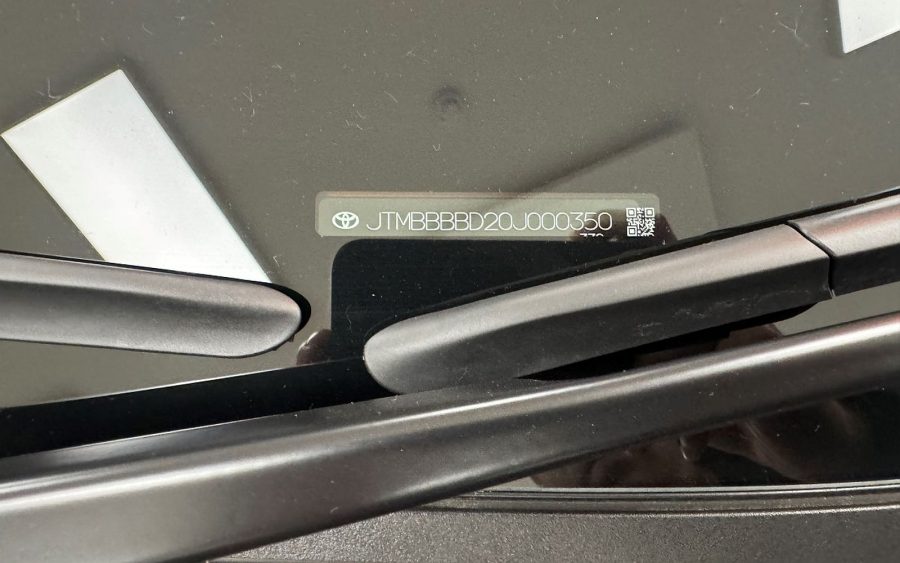
In most modern Toyota vehicles sold in the UK, you’ll find a visible Vehicle Identification Number through a special cut-out at the bottom of the windscreen.
VIN visible through windscreen
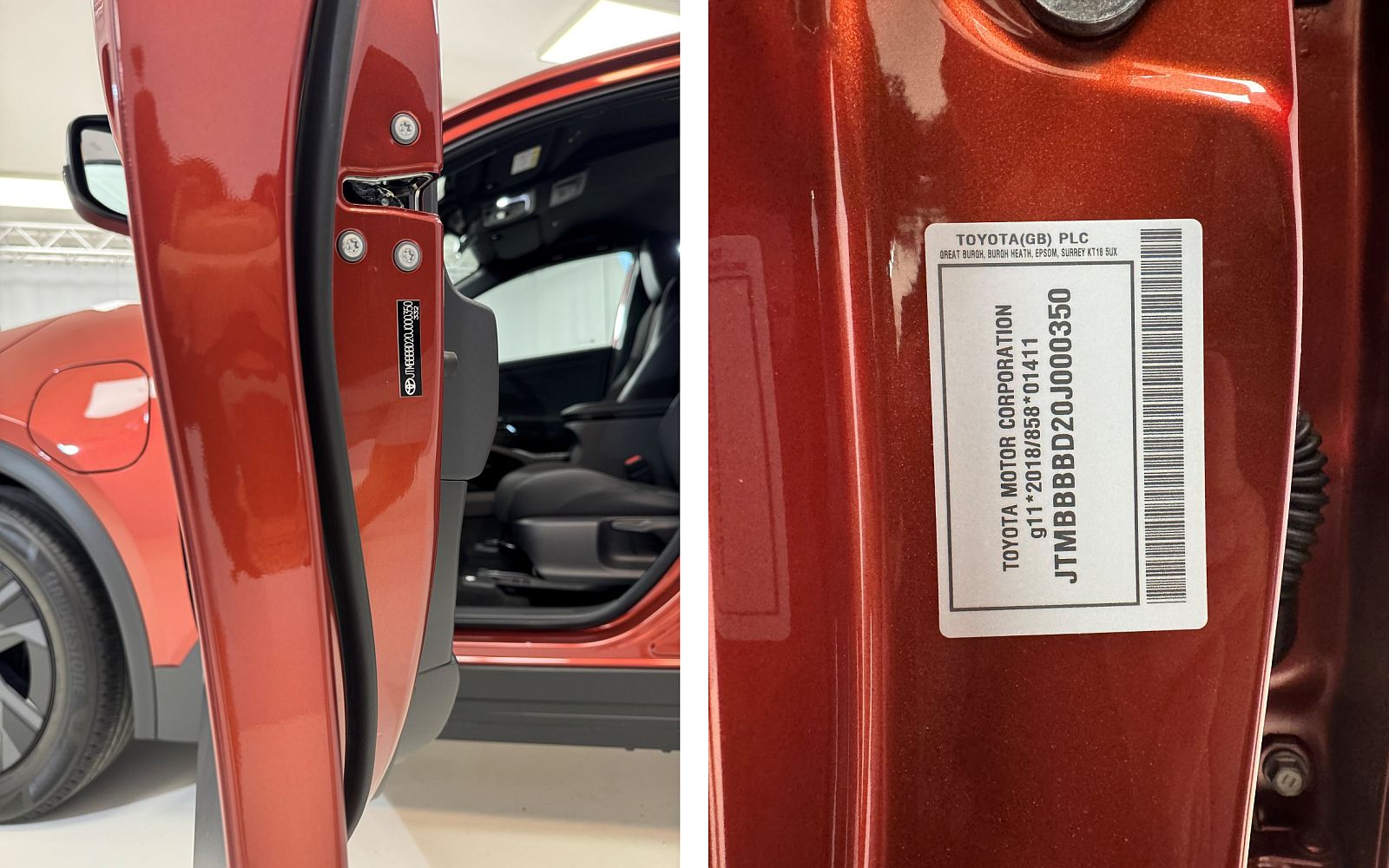
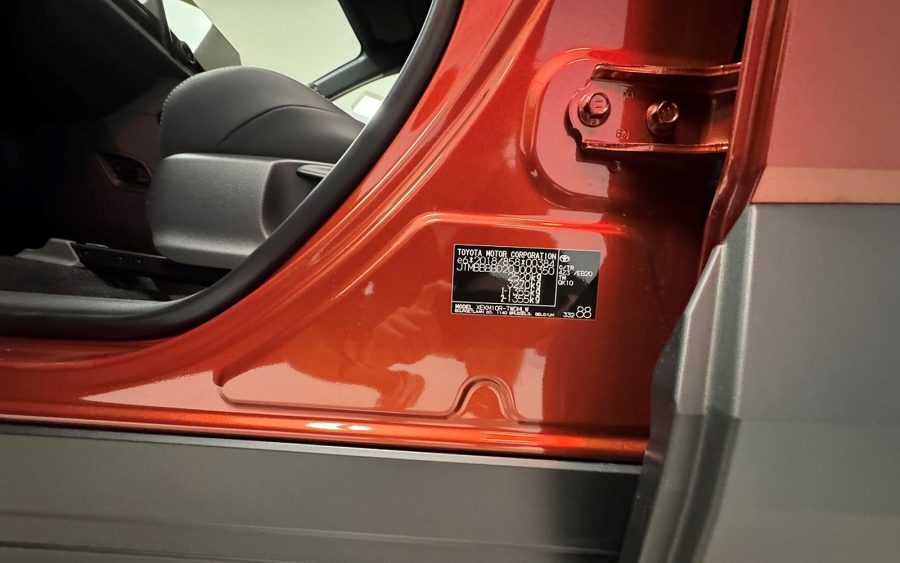
Additional VINs are repeated in a couple of places on the unibody chassis. One is stamped into the metal floor under the offside (driver’s side) front seat – usually visible behind a small flap cut into the vehicle’s carpet. The other is printed on a tamper-proof label located on the lower half of the nearside (kerb side) B-pillar.
VIN visible on the vehicle’s chassis
Finally, it’s often possible to locate the VIN stamped into a panel on the inside edge of one of the front doors.
VIN visible inside front door
There are a few additions to these standardised positions. Due to their separate body on frame construction, the latest Hilux and Land Cruiser models have an extra Vehicle Identification Number stamped into the underlying frame.
On the Hilux this stamp can be found behind the offside rear wheel, while on the Land Cruiser it is located behind the offside front wheel.
Finally, Proace and Proace Max vans have an additional VIN stamped into the centre of the chassis within the engine bay.
How do you read a VIN number?
Although there are exceptions to the rule, the first three digits of the Vehicle Identification Number usually refer to the country of manufacture, the vehicle maker and the vehicle type.
For example, if you check the first letter of the code, ‘J’ references Japan, ‘S’ references England, while ‘V’ identifies France. Turkey gets an ‘N’, while Thailand and South Africa (where some of our Hilux vehicles are produced) get an ‘M’ and ‘A’ respectively.
The second letter is usually ‘T’, which describes Toyota, the third describes which group of cars (or sometimes which chassis type) the vehicle sits on.
The next six numbers reference the car’s body style, engine and gearbox, while the remaining eight is a combination unique to the car, listing the year the car was made, the factory it was produced in and where it came in the production process.
Frequently asked questions (FAQs)
Is the VIN the same as a registration number?
No. A VIN is permanent to the vehicle, while a registration plate can be changed.
Can two cars have the same VIN?
No. Every VIN is unique to a specific vehicle.
Is it safe to share a VIN?
Generally yes, but it should only be shared when absolutely necessary.
How can I get more information?
Feel free to ask additional questions about Vehicle Identification Numbers in the comments section below, but please be aware that our support team can only answer queries related to the UK market. If you are not in the UK, please direct your query to the Toyota organisation in your country.
If you have specific technical concerns about your Toyota in the UK, please contact your nearest centre.


hello i just purchased a Toyota Hiace with CHASIS No: JT121UK1200005543. The Brain box is bad and I need to replace it.
i want you to assist me with the ECU NUMBER in order for me to place a replacement order.
Hi Olusegun,
Thanks for getting in touch. We would advise for you to contact your local Toyota Centre, as they will be able to assist you further.
Thanks.
Hi, Can I link body parts of a Toyota Hilux SR5 utility back to a Chassis/VIN, I have doors with windows, bonnet, tailgate, some dash components and want to match it back to its original Chassis/VIN
Thanks
Fletch
Hi Fletch,
Thanks for getting in touch. The VIN is for the chassis of a vehicle, not the body parts. The body parts have individual part numbers and therefore cannot be traced back to a specific VIN or chassis.
Thanks.
Vehicle tracking system is modern technology. It safe our vehicle, also we looking our vehicle. If you go unknown place, then GPS is best friend for find any location and safety.
Hi,
i Buy a Toyota Hilux Revo model 2018 2.8LV 4*4 (full option) with all new specs in Pakistan, unfortunately i lose my car reported to police already is there any way i can trace my car from gprs of car stereo system or any other way becayse i dont have tracker on the car.
Thanks,
Hi Hammad,
Thanks for getting in touch and we are sorry to hear about your car. We would advise for you to contact Toyota in your region, as they will be able to assist you further.
Hy
i want to knoethat where is the Vin of a Toyota Corolla gli 2011.
Hi Mehmood,
Thanks for getting in touch. The VIN number is usually referenced on a tamper-proof sticker located just inside the shut line of the front left hand (passenger side) door. We would recommend contacting Toyota in your local region who may be able to assist you further.
Thanks,
Katherine
My car has sent with one key , model aqua 2015. Is it true. How can I have a duplicate
Hi Roshinee,
Thanks for getting in touch. Unfortunately, we are only able to comment on UK vehicles however we would recommend contacting Toyota in your local region who will be able to assist you in obtaining a second key.
Thanks.
Hi, I have recently bought a 1992 MR2 mk2 Japanese import to the UK, and can’t find the VIN in any places I’ve checked so far (under front bonnet, passenger door). Any other tips on where it could be, or are you able to check it for me if I give you the UK number plate?
Hi Emily,
Thanks for getting in touch. If you could please provide the registration, we can locate the VIN number.
Thanks.
Hi, I bought a replacement Diesel engine for a 2007 Hilux D4D. It was supposed to have been a 1KD FTV but the crook sold me a 2KDFTV. Now it fits into the engine bay but does not work. The injectors and ECU and injector driver are required. How do I identify the VIN from the casting number or find the missing parts?
Hi Cletus,
Thanks for getting in touch. For help answering this question we would recommend contacting our national technical hotline, whose contact details you can find here: https://www.toyota-tech.eu/contact.aspx
Thanks.
Hi i need help with my chasisi number .how may i find it .am using my late husbands car and i recently lost the cheaped key .my mechanical needs a VIN or chassis number and said i can check on my car but where do i find it located on my car .my plate number is ALM 8491 .toyota avensis .thanks
Hi Esther,
In most modern Toyota cars, you’ll find a visible VIN through a special cut-out at the bottom of the windscreen. Additional VINs are printed on tamper-proof stickers located just inside the shut line of the front nearside door. Earlier models may have a metal plate instead of a sticker.
The VIN is repeated on the vehicle’s chassis, stamped into the metal floor of the car under the driver’s side front seat. It’s usually visible through a small flap, deliberately cut into the vehicle’s carpet.
Thanks.