

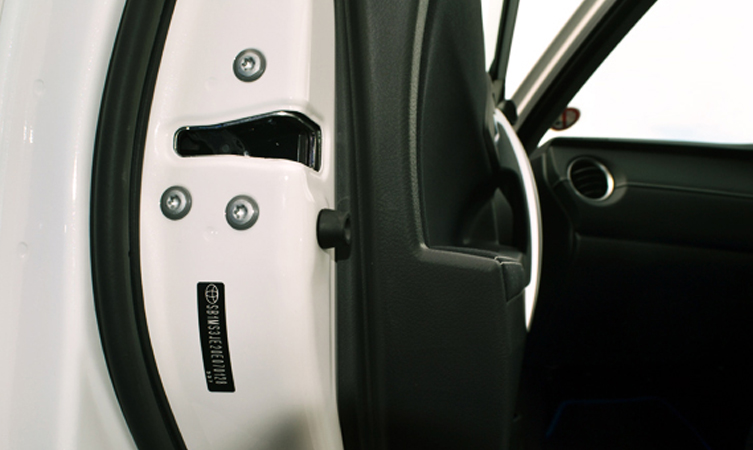
The Vehicle Identification Number (VIN) is your Toyota’s legal identifier, and is applied to your car during production.
Each VIN is unique, and is usually a 17-character code made up of letters and numbers, and reveals important details about your vehicle. As well as containing information on the time and place of your car’s creation, it also contains information about its specification and design.
First introduced in 1954, Vehicle Identification Numbers are an important component in determining the history and identity of a vehicle, particularly when combined with the car’s DVLA licence plate and V5 or V5C documents.
While licence plates can be altered, the car’s VIN remains unchanged, and therefore is the primary identification number for your Toyota.
How to locate your Vehicle Identification Number
In most modern Toyota cars, you’ll find a visible Vehicle Identification Number through a special cut-out at the bottom of the windscreen. Additional VINs are printed on tamper-proof stickers located just inside the shut line of the front nearside door. Earlier models may have a metal plate instead of a sticker.
The VIN is repeated on the vehicle’s chassis, stamped into the metal floor of the car under the right-hand (driver’s side) front seat. It’s usually visible through a small flap, deliberately cut into the vehicle’s carpet.
Read more How to connect your phone to your car
Of course, there are some important exceptions to the rule…
These include the four-door Hilux pick-up – in which the tamper-proof sticker is mounted just inside the nearside rear door, and the five-door Aygo – in which it is applied to the body just inside the offside rear door shut.
Decoding your Vehicle Identification Number
Although there are exceptions to the rule, the first three digits of the Vehicle Identification Number usually refer to the country of manufacture, the vehicle maker and the vehicle type.
For example, if you check the first letter of the code, ‘J’ references Japan, ‘S’ references England, while ‘V’ identifies France. Turkey gets an ‘N’, while Thailand and South Africa (where some of our Hilux vehicles are produced) get an ‘M’ and ‘A’ respectively.
The second letter is usually ‘T’, which describes Toyota, the third describes which group of cars (or sometimes which chassis type) the vehicle sits on.
The next six numbers reference the car’s body style, engine and gearbox, while the remaining eight is a combination unique to the car, listing the year the car was made, the factory it was produced in and where it came in the production process.
For more on your VIN, please contact your nearest dealer, or visit toyota.co.uk/mytoyota

Hi, I have this VIN number JTEFJ71500******, could you say me the fabrication year?
Hi Marco,
Thank you for you question.
This VIN does not appear in our systems. Please check whether there is an error.
Alternatively, please check with your local Toyota dealer for further guidance.
Many thanks,
Toyota UK
Hi I have bought a bakkie in Japan but and I am in Africa country Namibia, I have a problem with the Vin number on the car (GUN125-3944477) they are saying it’s not working on their system and now I am confused I don’t know if there is onther way to get the Vin number that will work in my country please help!
Hi Amoomo,
Thank you for your question.
To provide some guidance, the reason your VIN number does not register on their system, is probably because your vehicle in a Japanese import (therefore the VIN will be incompatible). Your VIN is correct on our system.
Please contact your local Toyota dealership for further assistance.
Many thanks,
Toyota UK
Hello. How about this VIN number?
SB1BE76LX0E015679
Hi Gabriel,
Please could you specify what you need assistance with?
Many thanks,
Toyota UK
Hi
I need a breakdown of YAREFYHT********* in order to find the factory it was built in for revenue in Ireland .
Hi Fiona,
Thank you for your question.
Please could you clarify what exactly you would like to know.
Many thanks,
Toyota UK
Hi .. my name is Andy and i bought my 1996 Toyota Celica (VIN JT164STL200109759) at Chelmsford Toyota during Dec1996 .. i would like to know (i) where it was manufactured, (ii) the engine size/type (3S-GE??) and (iii) Style/Trim configuration (ST-202??) .. i am curious because mine has a sun roof and water jets to clean the headlights .. i hope i am not asking for too much info .. the car and i currently live in Australia and sometimes it is difficult to find spare parts because the Toyota Celicas sold here seem to be a bit different ..
Cheers
Andy
Good afternoon Andy, thanks for your message.
We were able to track down the following info for VIN – JT164STL200109759;
Production – Japan
3S 2.0 Petrol
Katashiki: ST202R-BLMGFW – This code can help you identify trim and specs.
We hope this helps, thank you.
Thanks Toyota UK .. i should have given you my UK rego P9***** .. i’m not sure where or who i can contact to help identify Katashiki: S***2R-****** (although the ST202 certainly look normal) .. but i will try with my local Toyota dealer here in Frankston Vic or online .. anyway thanks so much for your reply ..
Cheers
Andy
How come that my toyota ch-r VIN starts with J even though all productions are in Turkey?
Hello Louie,
The VIN starting with “J” for the Toyota C-HR is a common misconception. In reality, the VIN system used for Toyota vehicles, including the C-HR, is based on the World Manufacturer Identifier (WMI) system. The first three characters of the VIN, which include “J,” are part of the WMI and do not indicate the country of manufacture. Instead, they are used to identify the manufacturer and the type of vehicle.
The VIN system is designed to be globally consistent, and the “J” designation does not imply that the vehicle was built in Japan. In fact, the C-HR is produced in Turkey, and the VIN system used for Toyota vehicles does not include the “J” designation.
We hope this helps.
Many thanks,
Toyota UK
Hi admin,
I am trying to find out the colour code of a specific part from a Toyota Yaris but only have the VIN. The VIN is VNKKD3D3********.
If you are able to find out the colour code of the car (hoping it is 8T7), do let me know.
Many thanks
Hi Awais,
Thank you for your question.
Yes, we can confirm that the paint code for your Toyota Yaris Hybrid is 8T7.
Please don’t hesitate to ask if you have any further questions.
Many thanks,
Toyota UK